
The job in brief
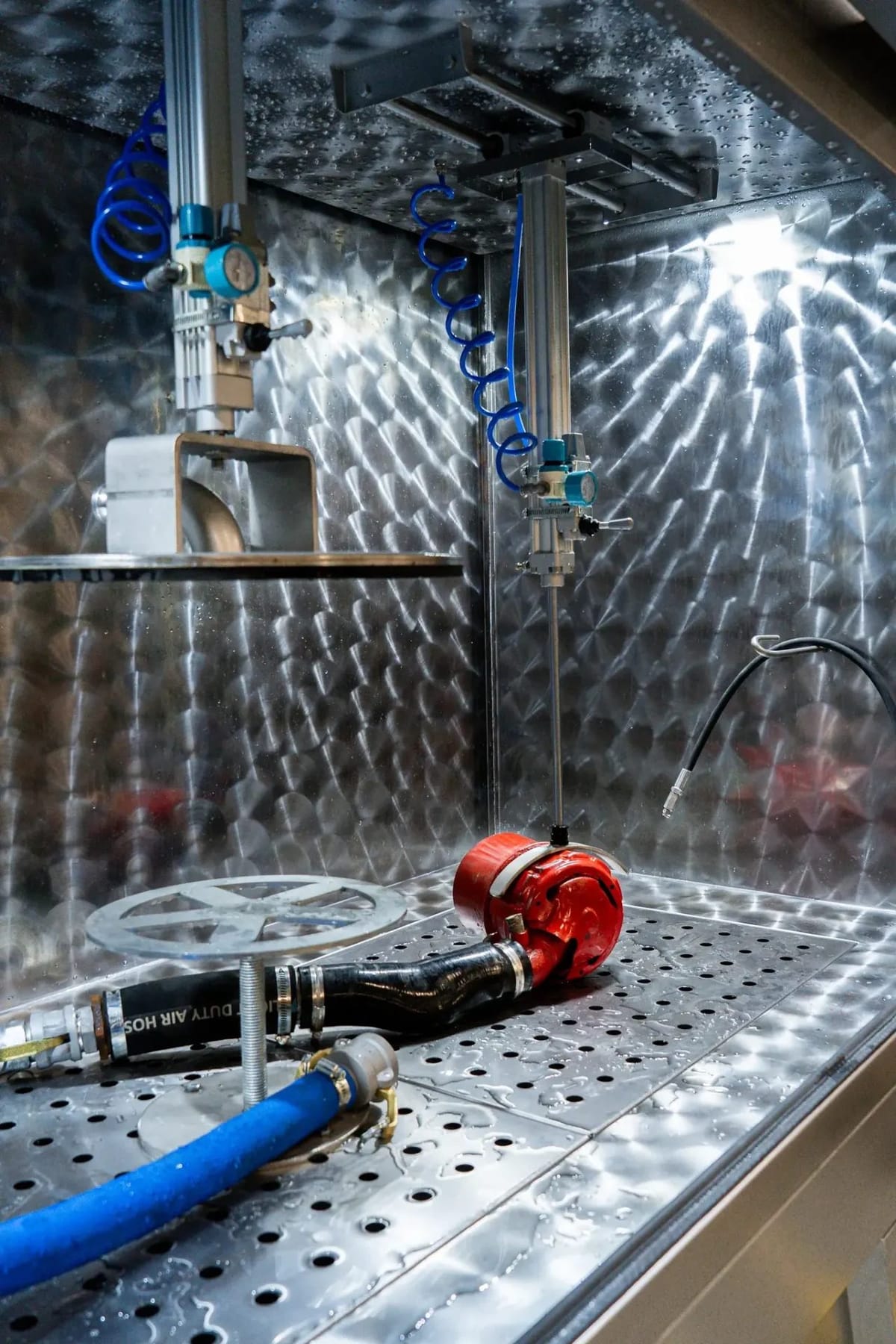
The operator checks the machine is ready, inspects the filter and fits an adaptor to the filter’s outlet so the wash runs against the normal exhaust flow. The filter is secured in the cabinet and the automatic sequence runs: a low-pressure prewash, the main wash, then high-pressure impact pulses. Compressed air then clears standing water, and the filter is dried, inspected and recorded before it goes back on the vehicle.
On the S, a back-pressure pre-test comes before the wash and the filter is dried with heated air. The E and V are simpler cabinets with strap restraint and a compressed-air purge instead of heated drying. The steps below follow MET’s operating instructions for each model, without the recommended times and settings, which are still being confirmed.
Before you start
Each manual opens with the same checks. The machine is connected to the electrical supply its instructions call for, with a compressed-air supply at the pressure they state. The water tank is full, the machine stands level, the machine’s own filters are free from heavy contamination, and the operator has been trained on that model.
The supply and air values differ by model and MET’s documents don’t all agree, so they are held on the machine pages until they are confirmed. The instructions do make one practical point clear: water heating is meant to be used only on the higher-rated electrical connection, so how a machine is wired affects whether it can heat its wash water.
Then inspect the filter itself. Work out which way the exhaust flows through it, and look at both faces for cracks, melting or missing material. Oil or coolant in the inlet points to an engine fault that needs fixing first. A damaged filter needs replacing, not cleaning.
- METClean S electrical supply
- Awaiting approval
- METClean S air supply
- Awaiting approval
- METClean E electrical supply
- Awaiting approval
- METClean V air supply
- 5–8 bar
A clean on the METClean S
The S is controlled from a touchscreen and holds the filter with a clamping ram. Its manual gives this sequence.
Fit the adaptor
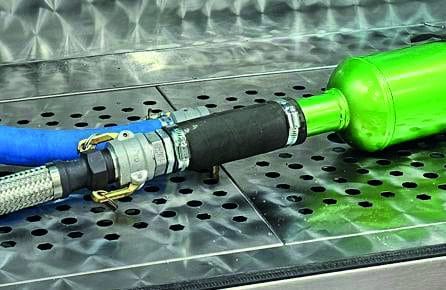
Choose a suitable adaptor, fit it to the filter’s outlet, secure any pipes and cables on the filter, and clamp the adaptor to the stainless braided wash hose.
Clamp the filter
Position the filter close to the clamping ram, facing away from the door, and secure it with the ram’s toggle lever. Check again that it is held firmly before going on.
Pre-test
Press Pre Test. The machine passes air through the filter to give a starting indication of how loaded it is, which goes on the printed record.
Automatic clean
Press Auto Clean to run prewash, wash and high-pressure impact. The soft start, wash length, pulse length and gap between pulses are all set on the screen; a more heavily blocked filter gets a longer soft start to protect it from the high-pressure stage.
Change hoses
When the sequence ends, a sounder and a red flashing beacon signal it. Swap the filter from the braided wash hose to the blue drying hose.
Hot dry
Press Hot Dry. Drying time and temperature are adjustable, and the sounder and beacon signal the end. A cold-dry setting also forces compressed air through to empty residual water.
The E, V and larger machines
The same principle applies across the range, but the controls and the way the filter is held change with each model.
METClean E
The filter sits on a platform in the cabinet and is held with the clamping straps supplied. After fitting the adaptor to the outlet and connecting the braided hose, the operator starts the programme, which runs prewash, wash and high-pressure impact. When it finishes, the E automatically blows compressed air through the filter to remove excess water.
The dry button runs further compressed air only. The manual is clear that this depends entirely on the capacity and flow of your compressor, so the result varies with the air supply you have. Tank temperature and wash length are set with up and down controls, and a separate switch turns the tank heater on and off.
METClean V
On the V, the filter is strapped in facing away from the door, and the door is closed with a two-handed action and locked with its clasp. The start button runs prewash, wash and high-pressure impact, and the wash length is set on a dial. The machine stops itself at the end, and the emergency stop ends the process at any point.
Before starting, the operator checks the air gauge shows at least the minimum pressure the manual gives and adjusts it with the control knob. Water pressure is varied on a dial that controls the pump’s variable-frequency drive, and the pulse intervals are set automatically. The dry function then clears excess water with compressed air. The V’s electrical supply should be protected by a twin-pole RCBO.
XL Multi+ and DPF Lite
MET’s earlier XL instructions describe the same sequence as the S, with a pneumatic door closed by two-handed operation. They don’t cover the current XL Multi+ control system or its multi-service work, so we don’t describe an XL Multi+ procedure here until MET confirms it. We don’t yet hold approved operating instructions for the DPF Lite bench machine either.
Drying and refitting
A filter has to be dry before it goes back on the vehicle. On the S, heated air dries the filter in the machine. On the E and V, the compressed-air purge clears standing water, and some filters need their final drying on the vehicle.
Some filters, mainly combined DPF and catalyst units, take up so much water during the wash that no machine will dry them. They need a DPF oven or a drive cycle on the vehicle. If the heater switch on the S trips during drying, the manual gives high water saturation as the reason, not a machine fault.
Before refitting, look at both faces again, record the result for the customer and make sure the fault that caused the blockage has been dealt with. Where the machine tests, compare the before and after readings taken on the same machine.
- METClean E hot drying
- Awaiting approval
- METClean E cold air purge
- Awaiting approval
- METClean S hot drying
- Yes, adjustable time and temperature
- METClean S cold air purge
- Yes, compressed-air purge
- METClean V cold air purge
- Yes, compressed-air purge
- METClean XL Multi+ drying
- Awaiting approval
Operator responsibilities and open questions
The operator is responsible for a secure filter before every start, for keeping hands out of the cabinet while it runs, and for stopping the machine if anything looks wrong. The S alarm screen gives the reason for any stoppage. Doors and clamping rams are trap points, and any maintenance starts with the machine isolated and locked off.
Every clean adds soot and ash to the wash water and the machine’s filters. Those filters need checking and cleaning between jobs as the instructions describe, and the used water, sediment and spent filters go to your approved waste route, never to a drain. Cleaning product is added only where the machine’s instructions specify an approved one.
Still to be confirmed with MET: measured stage and total cycle times under stated conditions, the recommended settings for each programme, the electrical and air requirements for each model, and the operating procedure for the XL Multi+. Until then those figures aren’t published.
Want to see the process?
Book a demonstration at MET or at your workshop.