
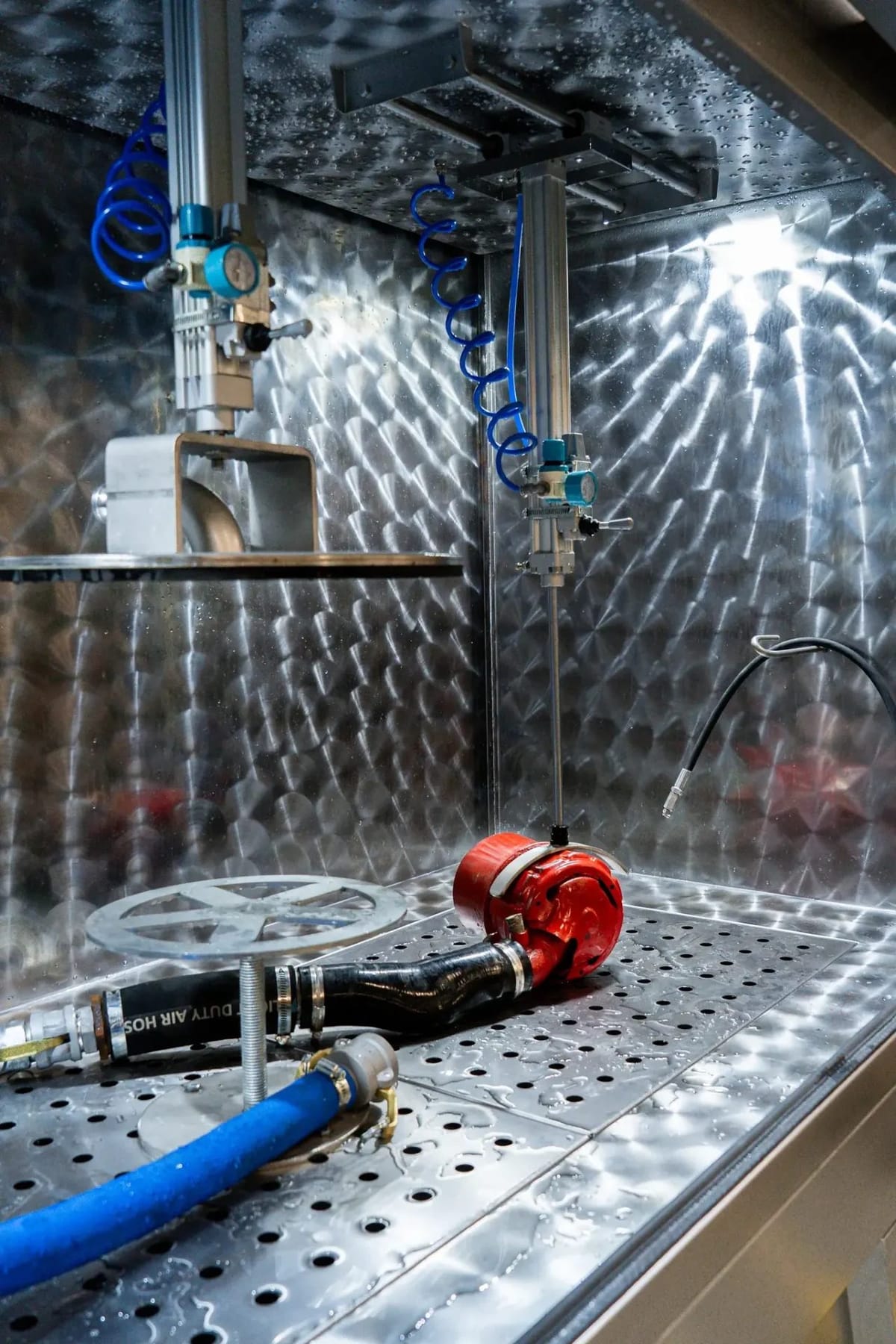
Four components, one cleaning method
A modern exhaust carries several after-treatment units, and each can block. A diesel particulate filter (DPF) traps soot from a diesel engine. A diesel oxidation catalyst (DOC) sits ahead of it and oxidises carbon monoxide and hydrocarbons. A selective catalytic reduction (SCR) unit reduces nitrogen oxides using AdBlue. A gasoline particulate filter (GPF) does the DPF’s job on petrol direct-injection engines.
All four are honeycomb or wall-flow structures that gas passes through, so they are cleaned the same way in a METClean machine: off the vehicle, connected at the outlet, and washed through against the normal exhaust flow so deposits leave the way they came in. That is what separates this from on-vehicle treatment, which works on soot and oil in a filter that stays fitted.
- DPF (diesel particulate filter)
- Traps soot from diesel exhaust. Soot burns off in regeneration; the ash left behind doesn’t, and builds up until the filter needs cleaning.
- DOC (diesel oxidation catalyst)
- A catalyst ahead of the DPF. Its inlet face can block with soot and oil residue.
- SCR (selective catalytic reduction)
- A catalyst that uses AdBlue to reduce nitrogen oxides. Deposits can build up in its channels.
- GPF (gasoline particulate filter)
- The petrol engine’s equivalent of a DPF, found on direct-injection engines.
How each component is cleaned
The technician works out the component’s exhaust flow direction, fits an adaptor to its outlet and connects it to the machine’s wash hose, then secures it in the chamber. The wash runs water through the component against the exhaust flow; on the S and XL Multi+ a soft start at low pressure comes first, followed by timed high-pressure bursts. The water carries ash, soot and other deposits back into the machine, where they are captured by its filtration before the water is used again.
Drying finishes the job. Compressed air clears standing water on every cabinet, and the S and XL Multi+ add heated drying. Combined units, such as a DPF with a catalyst in one housing, can hold more water than the machine can remove and are finished in a drying oven or by a drive cycle on the vehicle. Allow for that in your turnaround.
Inspect
Check for cracks, melting, missing material or soaking with oil or coolant. A damaged component needs replacing, not cleaning.
Connect at the outlet
Adaptor on the outlet side, so the wash runs against the exhaust flow.
Wash
The machine’s sequence runs and returns the water through its filtration.
Dry and check
Air purge, and heated drying where the machine has it. On the S and XL Multi+, a final back-pressure reading gives the after figure.
Which machines do it
METClean’s car and van cabinets (the E and S) and the heavy-duty XL Multi+ clean all four component types off the vehicle; choose by the size of the components you see and how much of the process you want the machine to run. The V does the same work from a van. Each model’s product record lists its components below.
- METClean E
- DPF, GPF, CAT, Intercooler, Radiator and EGR
- METClean S
- Awaiting approval
- METClean V
- Awaiting approval
- METClean XL Multi+
- DPF, SCR, EGR, Radiator and Intercooler
What it can’t do
Cleaning removes deposits; it doesn’t repair a cracked or melted substrate, restore a worn catalyst coating, or fix the fault that blocked the component. Components soaked in oil or coolant point to an engine problem that needs fixing first, and heavy contamination loads the machine’s water and filters faster.
If the blockage is mainly soot and the filter can stay on the vehicle, an on-vehicle treatment may be the quicker first step. When ash is the problem, or the component needs inspecting, it comes off and goes in the machine.
Bring your components
See a METClean machine clean a DPF, SCR, DOC or GPF from your own workshop.