
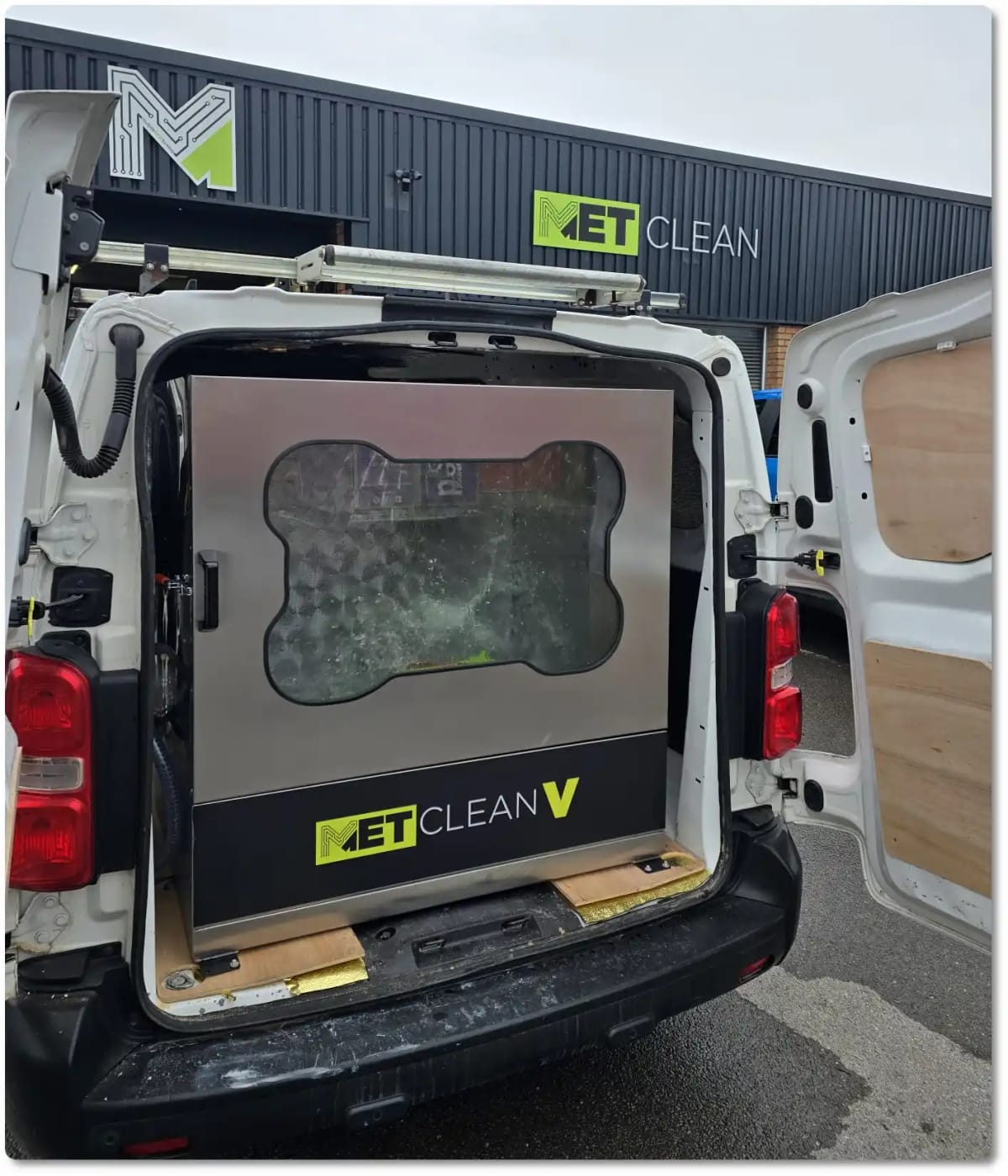
Short answer: you need more than a machine in the back of a van. A workable mobile DPF business needs a suitable vehicle, properly planned power and air, a safe installation, training, an approved waste route and enough local garages to keep the diary moving. The opportunity is strongest when you become the trade cleaner for garages that remove and refit the filter but do not want to send it away.
01 / The opportunity
Become the DPF cleaner local garages can call
Independent garages see blocked DPFs, but not every workshop has the space, budget or volume for its own cleaning machine. The usual choices are to send the filter away, fit a replacement or pass the job to another business. Each route can add delay, occupy a ramp or send part of the work elsewhere.
A mobile operator gives the garage another option. The garage diagnoses the vehicle, removes the filter and deals with the fault that caused the blockage. You arrive with the cleaning machine, clean the removed filter and hand it back for refitting. The garage keeps its customer and adds its margin. You charge a trade rate and build repeat work from businesses rather than relying only on one-off retail enquiries.
This is what Mobile Eco Tuning calls the trade hub model. It works particularly well for mobile mechanics and remappers who already visit garages, but it can also suit a new operator prepared to learn the technical side and build relationships before the van is finished.
Clean at the garage
The garage removes and refits. You clean on its premises, so there is no courier delay and the filter stays with the job.
Collect, clean and return
You group collections by area, clean in the van or at base, then return the filters on an agreed schedule.
Offer the complete job
If you are trained, insured and equipped for mechanical work, you can diagnose, remove, clean and refit for the vehicle owner.
The useful sales pitch
“You remove and refit the DPF as normal. I bring the machine to you, clean the filter here and return it during the same visit. You keep the customer and avoid sending the filter away.” That is easier for a garage owner to understand than a long explanation of pump technology.
For a fuller look at the model, see the METClean business case for a DPF cleaning machine and the dedicated page for mobile DPF cleaning equipment and van setup.
02 / The machine and van
What the METClean V needs around it
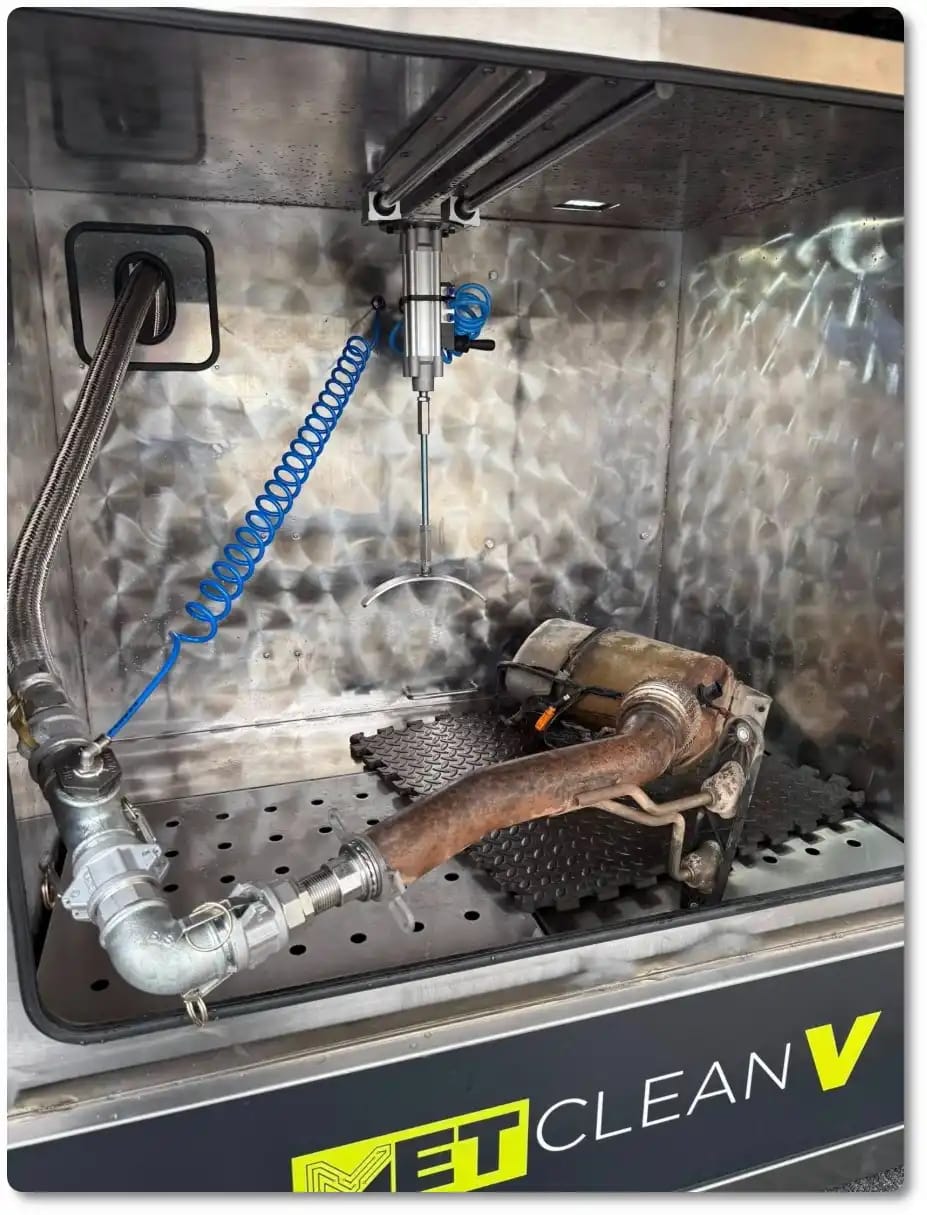
The METClean V is the cabinet MET designed for mobile work. It uses analogue controls, variable water flow, an automatic wash sequence and a compressed-air cold purge. Water is filtered and reused within the machine rather than being discharged at each customer.
The machine is only one part of the build. At its published operating weight, it is a substantial fixed load. The van’s payload, axle loads, floor, anchoring points, access and weight distribution must be checked for the actual vehicle. The power source and compressor also need to be sized for the full working cycle, not chosen from a headline figure or fitted as an afterthought.
| Requirement | Current METClean V specification | What it means for the van |
|---|---|---|
| External size | 903 × 1,178 × 1,145 mm (W × D × H) | Measure the usable load area, door opening and the space needed to work safely around the machine. |
| Weight | 150 kg empty; approximately 230 kg at published operating weight | Check the van’s remaining payload and axle loads after the machine, water, batteries, inverter, compressor, tools and driver are included. |
| Electrical supply | 220–250 V single phase, 50 Hz; draws 6 A (1.44 kW) from a standard 13 A supply | Use a suitable protected mains supply at the garage or a professionally designed on-board power system. |
| Air supply | 5–8 bar | You can use an agreed workshop air supply or carry a compressor sized for the machine’s wash and cold-air purge. |
| Water | Tank of 80 litres; 20–30 expected cleans per tank fill | Water condition, filter loading and maintenance affect the real change interval. Plan how the water is carried and changed through your approved waste route. |
| Drying | Cold air purge | The V does not use the heated drying system found on some workshop models. Machine drying is partial, and the filter finishes drying on the vehicle after refitting. |
| Training and warranty | Training and starter cleaning product included; 12-month warranty, with repairs at the MET factory | Delivery, van fitting and the adaptor kit are quoted separately, so include them in the startup budget. |
Mains power or an on-board system?
Plugging into the garage’s suitable mains supply is the simplest route and avoids carrying a large battery system. An engineered inverter and auxiliary-battery setup gives you more independence, but it adds cost, weight and installation work. MET can discuss the proposed van and power arrangement before you order. Do not buy the van, machine and electrical kit separately and hope they will fit together afterwards.
Use the METClean machine site-requirements guide to check power, air, water and installation in more detail. The live METClean V product page carries the current price, availability, purchasing options and product specification.
03 / The job itself
What happens at a garage
A mobile clean should be sold as a professional job, not a fixed number of minutes. The filter design, contamination, loading, diagnosis, setup, cleaning and cold-air purge all affect the visit. The machine stops at the time set by the operator, but the complete appointment includes far more than the wash cycle.
Confirm the cause and inspect the filter
Ask what caused the blockage and what has been repaired. Check the filter for cracking, melting, oil saturation or physical damage. Cleaning cannot repair a broken substrate or the vehicle fault that blocked it.
Connect and secure it correctly
Identify the exhaust-flow direction, choose the suitable adaptor and connect the machine so the filter is washed against the normal flow. Secure it in the chamber in line with the METClean V operating instructions.
Run the wash
Set the flow and time for the filter, close the cabinet and start the automatic sequence. The twin-stage filtration arrangement captures the removed material while allowing the water to be reused.
Use the time properly
Confirm the job details with the garage, plan the next stop or complete suitable work you are trained and insured to do. Do not book unrelated work so tightly that you cannot deal with the machine or customer if the job needs attention.
Cold purge and hand back
Use the compressed-air purge to remove excess water, then return the filter for refitting. Machine drying is partial, so the filter finishes drying on the vehicle.
Invoice and record the job
Record the customer, garage, vehicle or filter details, work completed, agreed price and payment. A repeatable record makes trade accounts, queries and return visits much easier to manage.
The 98% result
METClean achieves up to 98% restorative performance against a new filter when the filter is structurally serviceable. That is a cleaning-performance benchmark, not a promise that a cracked, melted or oil-damaged filter can be saved. Read what professional DPF cleaning cannot fix before accepting every filter that comes through the door.
04 / Running the route
Build a route that works in the real world
A route should be built around real distances and garages that are ready for you. Five cleans within one industrial estate is a different day from five filters spread across a 50-mile radius. Travel does not earn anything, so regular garages grouped by area are normally more valuable than isolated one-off jobs.
- Before leaving
- Check the machine, power, air, water, filters, adaptors and chemicals. Confirm that each garage has removed the DPF or knows exactly what part of the job you are providing.
- First visit
- Inspect and clean a filter already removed by a regular trade customer. Confirm the root cause has been dealt with and agree whether the garage or you will arrange any follow-up.
- Between jobs
- Group the next bookings by area, allow for traffic and leave enough time for loading, cleaning, cold purging, questions and payment. If your van uses an auxiliary battery, the charging plan must match the electrical design.
- At the end
- Check the water and filters, clean the work area, record what needs replenishing and keep waste contained for the approved return-to-base and disposal routine.
If you also offer remapping, the two services can sit naturally together because you already visit garages and the wash creates usable time. It is an additional service, not automatic profit. You still need suitable training, battery support, a legitimate file service and enough time to complete both jobs properly. See the guide to starting a remapping business and the AutoTuner tool supplied by Mobile Eco Tuning.
05 / Diagnosis and reputation
A clean filter will not repair the vehicle
A DPF normally blocks for a reason. That reason could be the way the vehicle has been used, but it can also be a pressure sensor, injector, glow-plug, EGR, turbo, oil-consumption or temperature-control problem. If the cause is still there, a cleaned filter can block again and the customer may blame the cleaning service.
That does not mean the mobile cleaner has to diagnose every vehicle personally. In the trade-hub model, the garage remains responsible for diagnosis, removal and refitting. Your job is to ask the right questions, inspect the removed filter and refuse work that is visibly damaged or outside the machine’s intended application.
The strongest operators agree the responsibilities before cleaning: who diagnosed it, what was repaired, who is removing and refitting it, and what happens if the substrate is damaged. Plain terms protect the relationship far better than promising that every filter will be “as new”.
06 / Waste, insurance and compliance
Put the right foundations in place before the first paid job
The removed soot, ash, contaminated water and spent filter media must not be emptied at a customer’s premises or poured into a drain. Keep them contained, return them to base and use an authorised waste route. Your waste contractor should help you identify the waste correctly and provide the appropriate records.
In England, businesses that transport waste generally need to register with the Environment Agency. The correct registration tier depends on whether you are carrying waste produced by your own work or waste produced by someone else. A mobile cleaning business can operate in different ways, so do not copy another garage’s registration. Describe the proposed service to the regulator and obtain the right answer for your business. Scotland, Wales and Northern Ireland use their own regulators and processes.
- Waste: confirm the carrier registration, waste description, storage, transfer paperwork and authorised disposal route that apply to the way you work.
- Insurance: explain mobile cleaning, customers’ parts, work at third-party premises, the van fit-out and any mechanical or tuning work to the insurer.
- Van installation: use competent installers for anchoring, power, battery, inverter and compressor systems, and check payload and axle limits.
- Customer terms: state what the service includes, what the garage must diagnose or remove, which damaged filters you will reject and how cancellations are handled.
- Accounts: let the accountant advise on the business structure, VAT, finance and capital allowances rather than choosing them from a blog.
Official starting points
Read the government guidance on registering as a waste carrier in England, the waste duty-of-care code and load-securing guidance for goods vehicles. These are starting points, not individual legal advice.
For the machine side, see how METClean handles filtration and water management.
07 / Prices and profit
Work backwards from the jobs you can actually win
The machine can create a valuable service, but the headline charge for a clean is not the profit. Start with the garages you can realistically serve, how often they currently send filters away and what trade price makes sense for both businesses.
Example figures
The opportunity in real numbers
A mobile route does not need five cleans every day to produce worthwhile sales. At an average charge of £200 per off-vehicle trade clean, five paid jobs a week produce £4,000 in sales over four weeks, or £48,000 over 48 working weeks.
Those figures are sales, not promised profit. They show why a compact group of repeat garage customers can make the model attractive without relying on an unrealistic five-stop route every day.
| Planning scenario | Average charge | Paid cleans each week | Sales over four weeks | Sales over 48 working weeks |
|---|---|---|---|---|
| Building the route | £180 | 3 | £2,160 | £25,920 |
| Regular trade route | £200 | 5 | £4,000 | £48,000 |
| Established route | £220 | 10 | £8,800 | £105,600 |
These are examples for testing the model, not forecasts. Your prices and volume will depend on the area, filter type, travel, whether the garage removes and refits the filter, and whether you provide diagnosis or other work. A complete removal, clean and refit can carry a higher invoice, but it also takes more time and creates additional labour, insurance and mechanical responsibility.
How to work out your own payback point
Start with the complete amount you are investing, not only the headline machine price. Include the van or van alterations, installation, power system, compressor, adaptors, insurance, waste setup, initial marketing and working capital. Then estimate what is left from each clean after its direct job costs.
Simple planning formula
Total startup investment ÷ amount left from each clean after its direct costs = estimated number of paid cleans needed to recover the investment.
For context, 75 cleans charged at £200 produce £15,000 in gross sales. That does not mean the machine has paid for itself after 75 jobs, because the £15,000 still has to cover every job cost and the rest of the startup package.
Costs that belong in the calculation
- Equipment and finance: machine, deposit, interest or lease payments, delivery, installation and additional adaptors.
- Vehicle: van purchase or finance, fuel, servicing, tyres, insurance, payload work and any battery or inverter system.
- Each cleaning job: chemicals, filters, water management, card fees, travel and authorised waste handling.
- Running the business: marketing, phone, software, accountant, breakdowns, warranty exclusions, tax and the value of your own time.
Once the fixed costs are covered, a well-planned route can become much stronger because several jobs share the same van, machine, insurance and marketing. Additional services such as diagnosis, removal and refitting, remapping or garage collection can increase the average invoice where you have the skills, equipment and insurance to provide them.
Use the METClean return-on-investment calculator to test your own price, volume, costs and finance assumptions. Run a cautious case, a likely case and a busy case so you can see how the plan behaves when bookings are slower or stronger than expected.
Current METClean V base-machine price: £14,995 + VAT. Prices and finance options can change, and delivery, van installation, additional adaptors and supporting equipment may be separate. Always use the live METClean V product page and a written quotation when making the decision.
08 / Finding the work
Build the garage route before the van is finished
A machine does not create customers on its own. Start with independent garages, diesel specialists, fleet workshops, van centres and mobile technicians within a sensible working area. Ask how they deal with removed DPFs now, how long it takes, what they dislike about the process and what would make them try a mobile service.
Do not open with a speech about micro-cavitation. Open with the operational result: the garage keeps the customer, avoids courier delay and has a local person to call. Leave a clear trade price, what the garage needs to do before you arrive, how to book and what area you cover.
Mobile Eco Tuning can supply a custom DPF-cleaning leaflet pack. Use it alongside personal visits, van signage, a Google Business Profile, a straightforward website and useful job photos. The leaflets support the conversation; they do not replace it.
Turn enquiries into workable bookings
METBooker for DPF specialists can list diagnosis, removal, cleaning, refitting and trade cleans as separate services. It can take deposits, check whether a mobile address fits your working area, keep the vehicle details with the booking and produce the invoice from the same job record. METBooker is a separate optional subscription and is not automatically included with the machine.
If you are planning a mixed mobile and workshop operation, the METBooker guide to booking and diary management explains coverage checks, travel time, drop-off limits, deposits and add-ons in more detail.
09 / Starting in the right order
Seven steps from idea to first job
- Check the local demand. Speak to garages before choosing equipment. Find out what they send away, how often and what turnaround they need.
- Choose the service model. Decide whether you will clean at garages, collect and return, or provide the complete mechanical job.
- Plan the van as one system. Check payload, axle loading, machine access, mounting, power, air, water, storage and waste before buying separate parts.
- Build the complete budget. Include the machine, installation, van, power, compressor, adaptors, insurance, waste, marketing and working capital.
- Put compliance and terms in place. Confirm waste registration and disposal, insurance, accounting and customer responsibilities.
- Complete training and test the workflow. Learn the machine, practise loading different filters and make sure the booking, payment and handover process works.
- Launch to the garages you already spoke to. Offer a clear trade service, keep the first route tight and improve it from real jobs rather than a spreadsheet forecast.
The separate mobile DPF cleaning business-plan checklist is useful when you want to turn those decisions into a printable launch plan. If equipment cost is the main obstacle, read the guide to DPF cleaning machine grants, finance and tax relief before signing an order.
10 / Common mistakes
What usually makes the plan go wrong
- Buying before speaking to garages. A technically good setup still needs paying customers within a workable route.
- Promising every filter can be saved. Cracked, melted or heavily contaminated filters may need replacing.
- Ignoring the reason it blocked. Cleaning the filter without addressing the vehicle fault creates repeat problems and unhappy customers.
- Planning power and payload separately. The machine, water, batteries, inverter, compressor, tools and driver all count towards the van’s real load.
- Quoting a wash time as the complete job time. Travel, inspection, loading, cleaning, drying, questions and payment all belong in the diary.
- Calling sales “profit”. The invoice value still has to pay every fixed and variable business cost, as well as you.
- Leaving waste until later. The approved storage, transport and disposal route needs to exist before the first paid clean.
11 / Questions garages and new operators ask
Mobile DPF cleaning FAQs
Do I need to be a mechanic to start a mobile DPF cleaning business?
You do not need to be a master technician to operate the machine, and METClean V training is included. You do need to inspect filters, recognise obvious damage and understand why DPFs block. A diesel-diagnostics background helps, or you can work with garages that retain responsibility for diagnosis, removal and refitting.
Can the METClean V run from a normal garage socket?
The current specification calls for a protected supply: 220–250 V single phase, 50 Hz; draws 6 A (1.44 kW) from a standard 13 A supply. The suitability of any socket and circuit must be checked. An on-board inverter and battery system is also possible when it is professionally designed for the complete machine and van installation.
How long does a mobile DPF clean take?
There is no honest single time for every filter. Loading, contamination, filter design, the selected wash time and the cold-air purge all vary. Build the booking around the complete visit rather than advertising the shortest possible wash cycle as the job time.
Can the METClean V clean truck and bus filters?
The V is intended for car and light-commercial-vehicle applications. Larger truck, bus and plant filters need a suitable larger machine, such as the METClean XL Multi+. Check unusual filters with MET before accepting the job.
Does the machine completely dry every filter?
The METClean V uses a compressed-air cold purge to remove excess water. Machine drying is partial, and the filter finishes drying on the vehicle after refitting. The V does not use the heated drying system fitted to some workshop models.
What is included when I buy a METClean V?
The current package includes the machine, training and starter cleaning product, with a 12-month warranty, with repairs at the MET factory. Delivery, van fitting and the attachment and adaptor kit are quoted separately. Confirm the complete package in writing before ordering.
Does buying a METClean machine include METBooker?
Not automatically. METBooker is a separate optional subscription for bookings, deposits, mobile coverage checks, payments and invoicing. Any package inclusion must be stated in the quotation.
How many DPF cleans are needed to recover the cost of a METClean V?
There is no fixed number because the charge, direct job costs and complete startup package vary. As a simple comparison, 75 cleans charged at £200 produce £15,000 in gross sales. That is not the same as £15,000 profit. Divide the complete startup investment by the amount left from each clean after direct costs to estimate a more useful payback point.
Sources and review standard
What this guide is based on
This article was reviewed on 14 October 2026 against the current METClean V specification, MET operating material, live METClean and METBooker guidance, and official waste and vehicle-load information. Prices, finance options and regulatory charges can change, so follow the linked live pages when making a decision.
- METClean V machine specification
- METClean mobile DPF cleaning and van requirements
- METClean filtration and water management
- METBooker for DPF specialists
- GOV.UK: register or renew as a waste carrier, broker or dealer
- GOV.UK: waste duty-of-care code of practice
- GOV.UK: securing loads on goods vehicles
Important: this is general business information, not individual legal, engineering, insurance, tax or financial advice.
Ready to turn the idea into a proper setup?
Choose the machine, check the van and get the complete quote
Tell Mobile Eco Tuning how you plan to work, what van you have and whether you intend to use workshop mains or an on-board supply. The team can explain the METClean V, training, delivery, van fitting and the additional equipment your proposed setup needs.