
The short answer
A filter loaded with soot and ash resists flow more than a clean one. The METClean S measures that resistance by passing air through the filter before the wash, and its product record lists testing before and after cleaning. Comparing the two readings shows how much the clean changed the filter, and the printed record ties the result to the filter’s serial number, the customer and the technician.
A reading is useful evidence, but it depends on the machine, its air supply and the filter, and it can’t see cracks, faults or the reason a filter blocked. Read it alongside a visual inspection and the vehicle’s own diagnostics, never instead of them.
- Back-pressure
- The resistance a filter puts up to flow through it, shown as a pressure difference. Higher means more restricted.
- Pre-test
- The METClean S reading taken before cleaning, to show how loaded the filter is to start with.
- Millibar (mbar)
- The unit the S instructions use for the reading. One millibar is a thousandth of a bar.
How the S pre-test works
The pre-test uses the same set-up as the clean, so it adds no handling. Its length is one of the S wash settings, which means the duration should stay the same from filter to filter if readings are to be compared.
Fit and clamp the filter
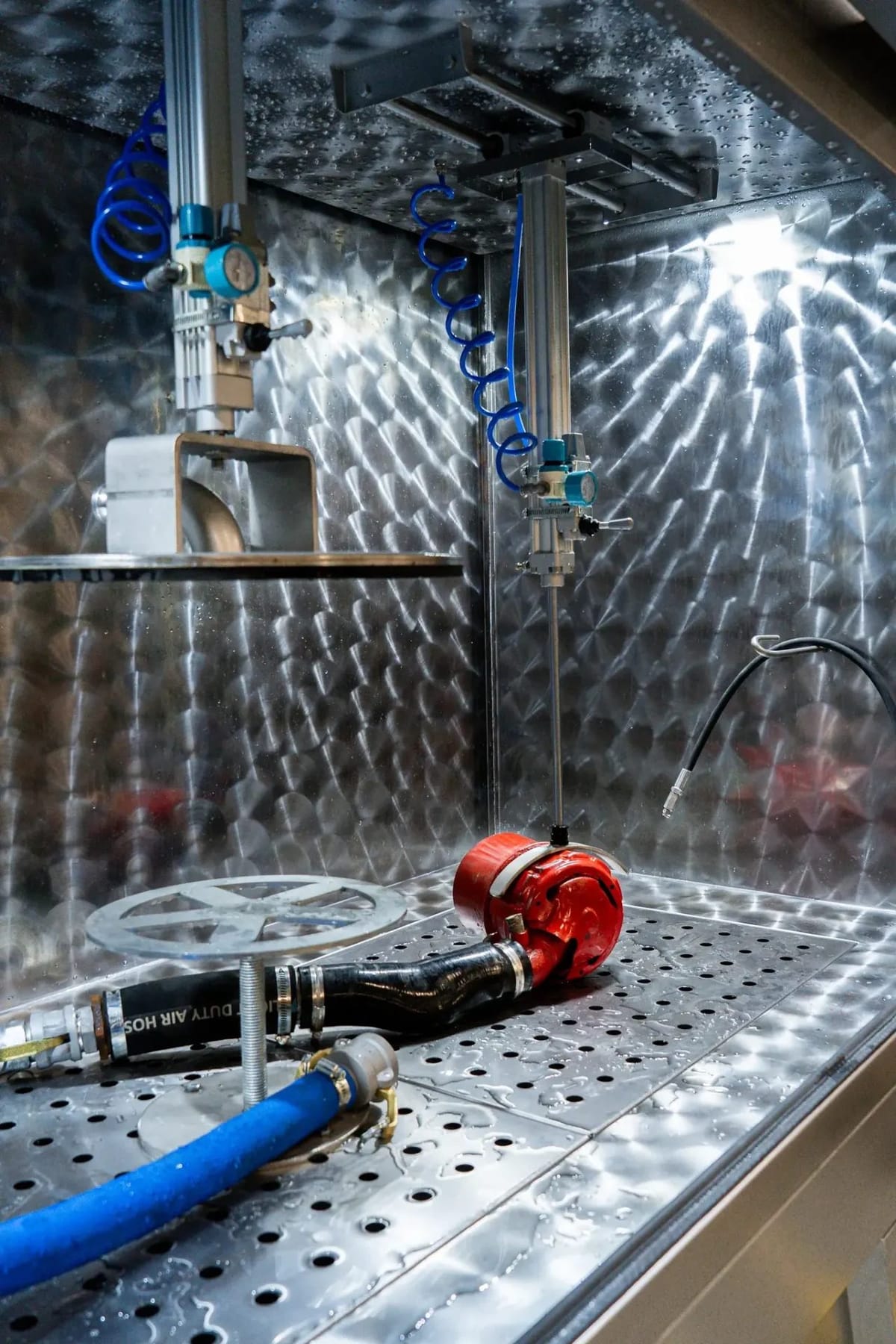
Fit the adaptor to the filter’s outlet, connect the braided hose and secure the filter with the clamping ram, exactly as for cleaning.
Run the pre-test
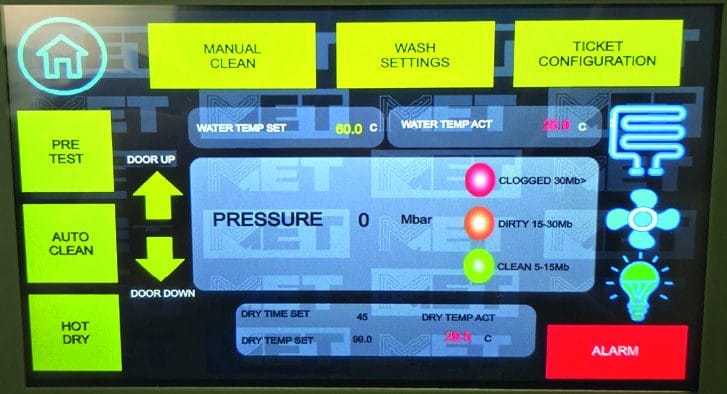
Press Pre Test on the main screen. The machine passes air through the filter for the set time and gives an initial assessment of how loaded it is.
Clean, dry and test again
After the automatic clean and hot dry, test the filter again. The S product record lists testing after cleaning as well as before; doing both on the same machine keeps them comparable.
Print the record
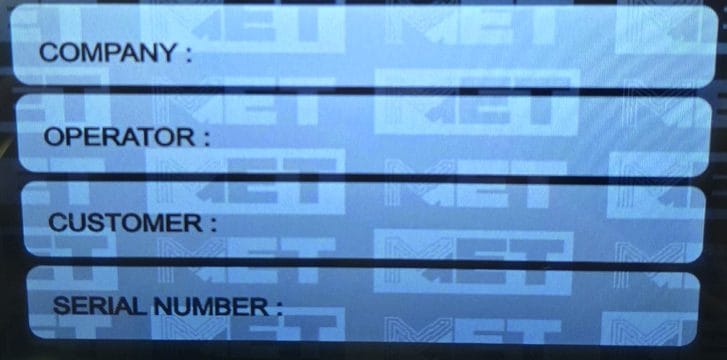
Print the result with the company, technician, customer and filter serial number filled in from the printer settings.
What goes on the printout
The S printer settings hold four fields, so each record identifies who cleaned which filter for whom. The serial number is the useful one for a fleet or a repeat customer: it lets you compare the same filter’s readings at its next clean.
A printout is a record of what your machine measured, not a certified test report. Describe it to customers that way, alongside what you saw on inspection.
- METClean S testing
- Yes, before and after cleaning
- METClean S printout
- Yes, company, operator, customer, filter serial number
- Company
- Your business name.
- Operator
- The technician who cleaned and tested the filter.
- Customer
- The owner of the filter.
- Serial number
- The filter’s own number, logged so the record can be traced to that unit.
What a reading can and can’t prove
A reading depends on the air the machine passes through the filter, and that air comes from your compressor and supply. A different compressor, a pressure drop on a shared airline or a different test length will change the number. Readings are only comparable when they are taken on the same machine, with the same settings and supply.
Filter type and size matter just as much. A large commercial filter and a small car filter won’t read alike when equally clean, so a single number means little without knowing what was tested. The trend for one filter, before and after, is what carries meaning.
A low reading doesn’t prove a filter is sound. A crack or melted section can let air bypass the walls, so a damaged filter can read freely. Nor does a reading show oil contamination, a failed sensor or an engine fault that will block the filter again.
The S instructions print interpretation bands for the pre-test. MET hasn’t yet confirmed the test method, filter conditions and wording behind them, so we don’t publish those bands or say a filter has passed or failed on a reading alone.
Testing on other models
The E instructions describe no pre-test step, and the V instructions don’t either. The gauges on the V relate to its air supply and filter housing; they aren’t a filter test. MET’s earlier XL instructions describe a pre-test like the S, but they predate the XL Multi+ and don’t document its controls, so XL Multi+ testing is held until MET confirms it.
Where a model doesn’t test, the clean is judged by inspection and by the vehicle afterwards: a clear view through the channels, the differential pressure sensor’s live data once refitted, and regeneration behaving normally.
- METClean E testing
- Awaiting approval
- METClean E printout
- Awaiting approval
- METClean V testing
- Awaiting approval
- METClean XL Multi+ testing
- Awaiting approval
Good practice and open questions
Inspect before you test, test under the same conditions each time, and record the result with the inspection notes and any fault found on the vehicle. Make sure the filter is fully dry before it is refitted. The test itself passes only air; the soot and ash from the clean stay in the machine’s water and filters for approved disposal.
Still to be confirmed with MET: the exact test method and conditions, what the printout shows beyond its header fields, whether the after-clean test runs with the same settings as the pre-test, and whether the E, V and XL Multi+ can test at all. Until then, readings stay in your workshop records rather than on this site as benchmarks.