
What sending filters away really costs
When a filter needs an off-vehicle clean, a garage without a machine has two choices. It can fit a new filter, which is the expensive answer many customers won’t accept, or it can remove the filter, send it to a cleaning service and wait for it to come back. The second option is cheaper for the customer but costly for the garage in less obvious ways.
The car sits in a bay or on your forecourt while the filter is away, holding up space you could be earning from. You pay the cleaning service, so most of the margin on the clean goes to them. And you have no control over how the filter was cleaned or when it comes back, yet your customer holds you responsible if it blocks again.
Bringing the clean in-house addresses all three. The filter can be cleaned and refitted in the same visit, the margin stays in your business, and you can see the filter before and after. The question is whether you see enough filters to justify the machine.
Why on-vehicle treatment isn’t enough
A filter collects two kinds of deposit. Soot is unburnt carbon, which burns off during regeneration and can be helped along by on-vehicle treatments. Ash is the non-combustible residue of engine oil additives, and it builds up over the filter’s whole life however often the vehicle regenerates.
On-vehicle treatments remove soot and oil residue, not ash. Once a filter is loaded with ash, it keeps blocking, and what remains is an off-vehicle clean or a replacement. That is the work a cleaning machine brings in-house, and it is why garages that already offer on-vehicle treatment still lose jobs without one.
Choosing the machine
Set your DPF cleaning machine cost against the jobs you send away now in the payback calculator, then spread it with DPF cleaning machine finance.
Choose by the filters you see, how often you see them and the space you have, not by the biggest machine you can afford. A machine too small for your filters turns work away; one far larger than your volume ties up capital and floor space.
- METClean E
- The entry cabinet for a garage that cleans car and van filters occasionally or regularly. An automatic cycle set from analogue controls, a cold-air dry and an included adaptor kit.
- METClean S
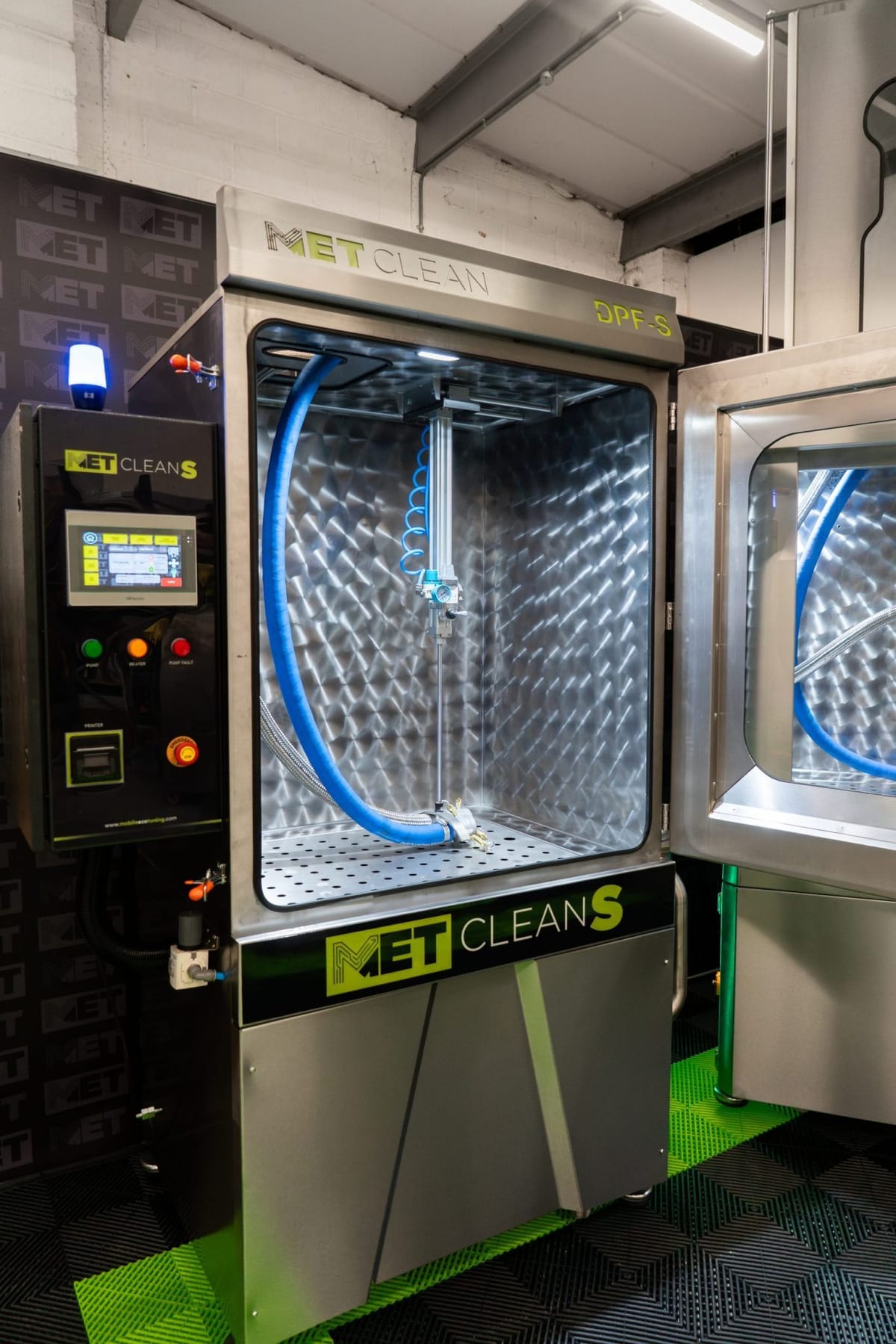
- For a busier car and van workshop, or one cleaning for neighbouring garages, that wants touchscreen DPF and GPF programmes, pneumatic clamping, heated drying and a printed record of each job.
- METClean XL Multi+
- For high-volume work and heavy-duty filters from trucks, buses and plant, where the filters are larger and downtime is expensive.
Space, utilities and waste
A cleaning cabinet needs floor space with room to load filters safely, an electrical supply suited to the model, compressed air at the right pressure and a water supply to fill the tank. Machines with heated drying generally need a larger supply than those that dry with cold air, so check your workshop’s electrics before choosing.
Used water and sediment stay in the machine’s tank and filters between cleans. When the water reaches the end of its useful life, it goes with the sediment and spent filter elements through your licensed waste route, never into a drain. The figures below come from the product record.
- METClean S electrical supply
- 240 V single phase on a 32 A supply with RCD; runs from a 13 A plug without water heating or hot air
- METClean E electrical supply
- 240 V single phase on a 32 A supply with RCD; runs from a 13 A plug without water heating
- METClean S air inlet pressure
- 5 bar
- METClean E air inlet pressure
- 5 bar
- METClean S external dimensions
- 1,640 × 800 × 2,100 mm (W × D × H)
- METClean E external dimensions
- 1,320 × 800 × 2,060 mm (W × D × H)
Cleaning in the working day
In a garage, the clean fits inside a normal repair job. The machine runs its cycle on its own, so the technician isn’t standing beside it.
Diagnose
Read the fault codes and find out why the filter blocked. A faulty sensor, injector, EGR valve or turbo has to be fixed or the filter will block again.
Remove and inspect
Take the filter off and check it for cracks, melting and oil or coolant contamination. A damaged filter needs replacing, not cleaning.
Clean
Fit the adaptor, secure the filter and start the cycle, washing against the exhaust flow.
Use the cycle time
While the machine works, carry on with the car: the repair that caused the blockage, a service or any other work the customer has agreed.
Refit and adapt
Refit the filter, which finishes drying on the vehicle within minutes, clear the codes and run any adaptation or relearn the vehicle needs.
Hand over
Explain to the customer what was found and fixed, including the root cause. Machines that record a result give you something to show them.
Selling it, training and support
For many customers, cleaning is the alternative they hoped for when told their filter needs replacing, at a much lower cost, provided the filter is undamaged. Explain that a clean removes the ash a regeneration can’t, and that the cause has been fixed. Many will prefer that to a new filter.
Once you have a machine, neighbouring garages without one are customers too. Offering them a trade rate brings in filters you didn’t remove yourself and helps the machine pay its way. The S and the XL Multi+ come with a marketing pack, leaflets or a leaflet drop with help on your web listings, to introduce the service locally.
On the UK mainland (excluding the Highlands), the S comes with delivery, and installation and on-site training are included where your site meets the minimum requirements. The E is installed by the buyer with remote onboarding from MET, or fitted and trained on site at extra cost. Training doesn’t replace judgement: your technicians still decide whether a filter is worth cleaning.
- METClean S training
- On site at installation, for whoever is there on the day, with a signed handover sheet. Free remote refresher training for new staff.
- METClean S installation
- MET delivers and positions the S, connects it to the supplies you have ready, then fills it and runs a test clean. Included where your site meets the minimum requirements.
- METClean E training
- Instructional videos and remote onboarding; on-site training at extra cost, quoted per job. Free remote refresher training for new staff.
- METClean E installation
- Usually installed by the buyer, with remote onboarding from MET; MET can fit it at extra cost, quoted per job.
Bringing DPF cleaning in house
What’s the best DPF machine to bring DPF cleaning in house?
For most car and van garages, the METClean S, the best garage DPF cleaning machine we make. On a budget and happy to self-install, the E. For HGV and plant filters, the XL Multi+.
Which DPF cleaner pays its way in a garage?
That depends on your own jobs and prices. Run each METClean through the payback calculator to see which DPF cleaner fits your numbers.
Mistakes to avoid
- Ignoring upstream faults
- Cleaning a filter without fixing what blocked it brings the car back, and the customer blames the clean.
- No plan for finding work
- A machine cleaning only the filters you happen to see may sit idle. Tell existing customers and nearby garages before it arrives.
- Buying too small
- A machine that can’t take the filters you regularly see, or can’t keep up with your volume, sends work back out of the door.
- Skipping the numbers
- Run your own prices and volumes through the calculator, including trade work, before deciding which machine and how to pay for it.
See it on your filters
Ask for a demonstration or a quote and we’ll check your filters, volume and workshop with you.