
The short answer
A diesel particulate filter (DPF) traps soot from the exhaust and the vehicle burns it off during regeneration. Ash, left behind by engine oil additives, doesn’t burn, so it stays in the filter and slowly takes up capacity. Burning harder or adding a treatment on the vehicle can’t shift it. The filter has to come off and be washed out.
A cleaning machine does that wash. The filter is sealed to the machine with an adaptor on its outlet, so water enters the way exhaust gas leaves and carries deposits back out of the inlet face. The machine starts gently, runs its main wash and high-pressure pulses, filters the returning water for reuse, then blows the filter through with compressed air and, on some models, dries it with heated air.
Cleaning removes deposits from a sound filter. It doesn’t repair a cracked or melted substrate, and it doesn’t fix whatever made the filter block, so inspection before and diagnosis of the vehicle are part of the job, not optional extras.
Terms used in this guide
- Regeneration
- The vehicle raising exhaust temperature to burn trapped soot. It can be passive while driving, active under engine control, or forced with diagnostic equipment.
- Substrate
- The ceramic honeycomb inside the filter. Alternate channels are closed at each end, so gas has to pass through the porous channel walls, which is where soot and ash are caught.
- Back-pressure
- How strongly a filter resists flow through it. A loaded filter resists more. Some machines measure it before cleaning; see pressure testing and reporting.
- Adaptor
- The fitting that seals the filter to the machine’s wash hose, so water and air go through the filter rather than around it.
- Off-vehicle cleaning
- Removing the filter and cleaning it in a machine. On-vehicle cleaning treats the filter while it stays fitted.
Soot, ash, oil, damage and faults are different problems
A filter that keeps blocking can have one of several causes, and each one needs a different response. Treating them as one problem is the commonest reason a cleaned filter comes back.
- Soot
- Unburned carbon from combustion. It is combustible, so regeneration or an on-vehicle treatment can deal with it, and a machine wash removes it too.
- Ash
- Non-combustible residue from engine oil additives. It survives every regeneration and builds up over the filter’s life. Only off-vehicle cleaning removes it.
- Oil or coolant contamination
- Oil or coolant reaching the filter points to an engine problem upstream. It can saturate or glaze the substrate, and the engine needs repairing before a clean is worth doing.
- Physical damage
- A cracked, melted or broken substrate. Cleaning can’t repair it, and a damaged filter should be replaced.
- Diagnostic faults
- Faulty injectors, EGR or intake problems, failed pressure or temperature sensors, or driving that never lets regeneration finish. Any of these will block a cleaned filter again unless it is found and fixed.
On the vehicle or off it
MET also supplies an on-car flush. Its instructions describe a two-stage treatment introduced into the filter through the pressure pipe or temperature-sensor opening, with the engine run and the vehicle driven afterwards. The same instructions state plainly that the process removes soot and oil residues, not ash, and that vehicle faults must be fixed first. Fluid can run from the tailpipe, so it is caught in a container and sent to a waste management company.
On-vehicle treatment suits a filter loaded mainly with soot on a vehicle whose fault has been put right. Once ash is the problem, or the filter is old and has been through many regenerations, the filter needs to come off. Off-vehicle cleaning also lets you look at both faces of the filter, so cracking or melting can be spotted before it goes back on.
What happens inside the machine
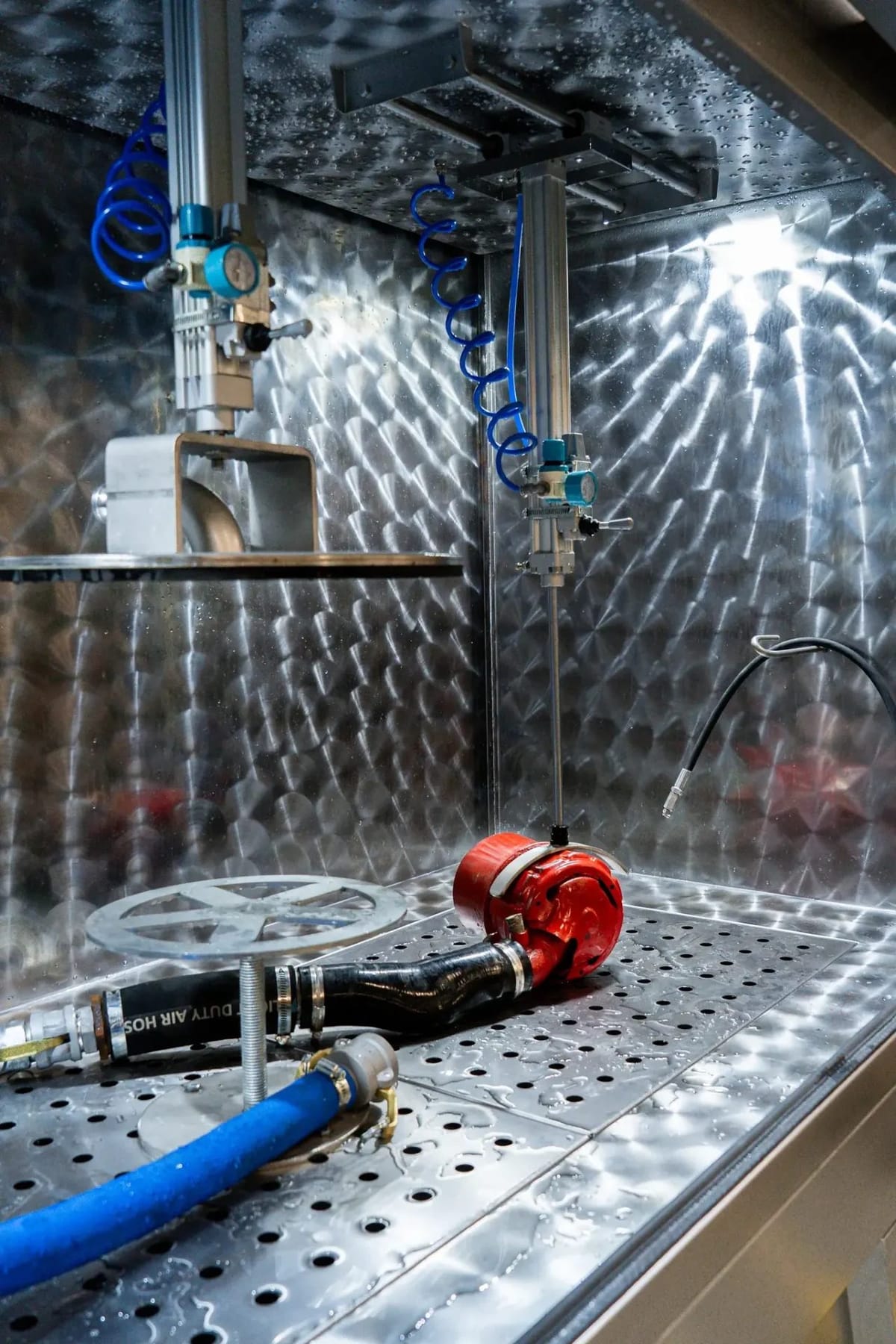
The operator checks which way the exhaust flows through the filter, fits an adaptor to its outlet and connects it to the machine’s braided wash hose. The filter is secured in the cabinet, by a clamping ram on the S and straps on the E and V, and the door is closed.
The automatic sequence in MET’s instructions runs prewash, wash, then high-pressure impact. The prewash is a soft start at low pressure, so a heavily loaded filter isn’t hit at full pressure straight away. The main wash circulates water through the filter, and short high-pressure pulses at set intervals help dislodge packed deposits. Water leaving the filter drains back to the machine and passes through its filters before it is pumped round again.
At the end, compressed air is forced through the filter to push out standing water. The S then switches to a separate drying hose for heated air; the E and V rely on compressed air alone. Some filters, mainly combined DPF and catalyst units, hold too much water to dry in the machine and are finished in an oven or by a drive cycle on the vehicle.
DOC, SCR, GPF and other components
A modern exhaust usually carries more than one after-treatment unit, and the same machines are often used on cooling and intake parts too. A diesel oxidation catalyst (DOC) oxidises carbon monoxide and hydrocarbons, usually ahead of the DPF. A selective catalytic reduction (SCR) unit reduces nitrogen oxides using AdBlue. A gasoline particulate filter (GPF) does the DPF’s job on petrol direct-injection engines. A catalytic converter (CAT) is the general petrol or diesel catalyst. Intercoolers, radiators and EGR valves are engine parts that collect deposits of their own.
METClean machines clean DPFs, SCR catalysts, DOCs and GPFs off the vehicle in the same way, and each model’s product record lists its components below. Combined DPF and catalyst assemblies can hold more water and may need finishing in an oven or on the vehicle.
- METClean E
- DPF, GPF, CAT, Intercooler, Radiator and EGR
- METClean S
- Awaiting approval
- METClean V
- Awaiting approval
- METClean XL Multi+
- DPF, SCR, EGR, Radiator and Intercooler
Limits, safety and what is still open
A machine cleans; it doesn’t diagnose. It can’t tell you why a filter blocked, and a back-pressure reading where the machine takes one is evidence for your records, not a certificate that the filter is serviceable. A clean is not a guarantee of how long the filter will last on a vehicle whose fault hasn’t been found.
MET’s safety instructions cover electrical hazards, trap points at doors and clamps, and lockout before any maintenance. Operators should be trained, wear gloves, eye protection and safety footwear, and keep clear of moving parts while the machine runs. Electrical work inside the machine is for a qualified, competent person only. Filters, used water and captured sediment contain soot and ash and go through an approved waste route, never to a drain.
Some technical points are still being confirmed with MET: the component types each model is approved for, how catalyst-coated parts should be treated, and the measured length of each stage under stated conditions. Until they are confirmed, the machine pages show those values as Awaiting approval rather than estimates.
See it on your own filters
Book a demonstration and bring the kind of filters you work on.